Abstract
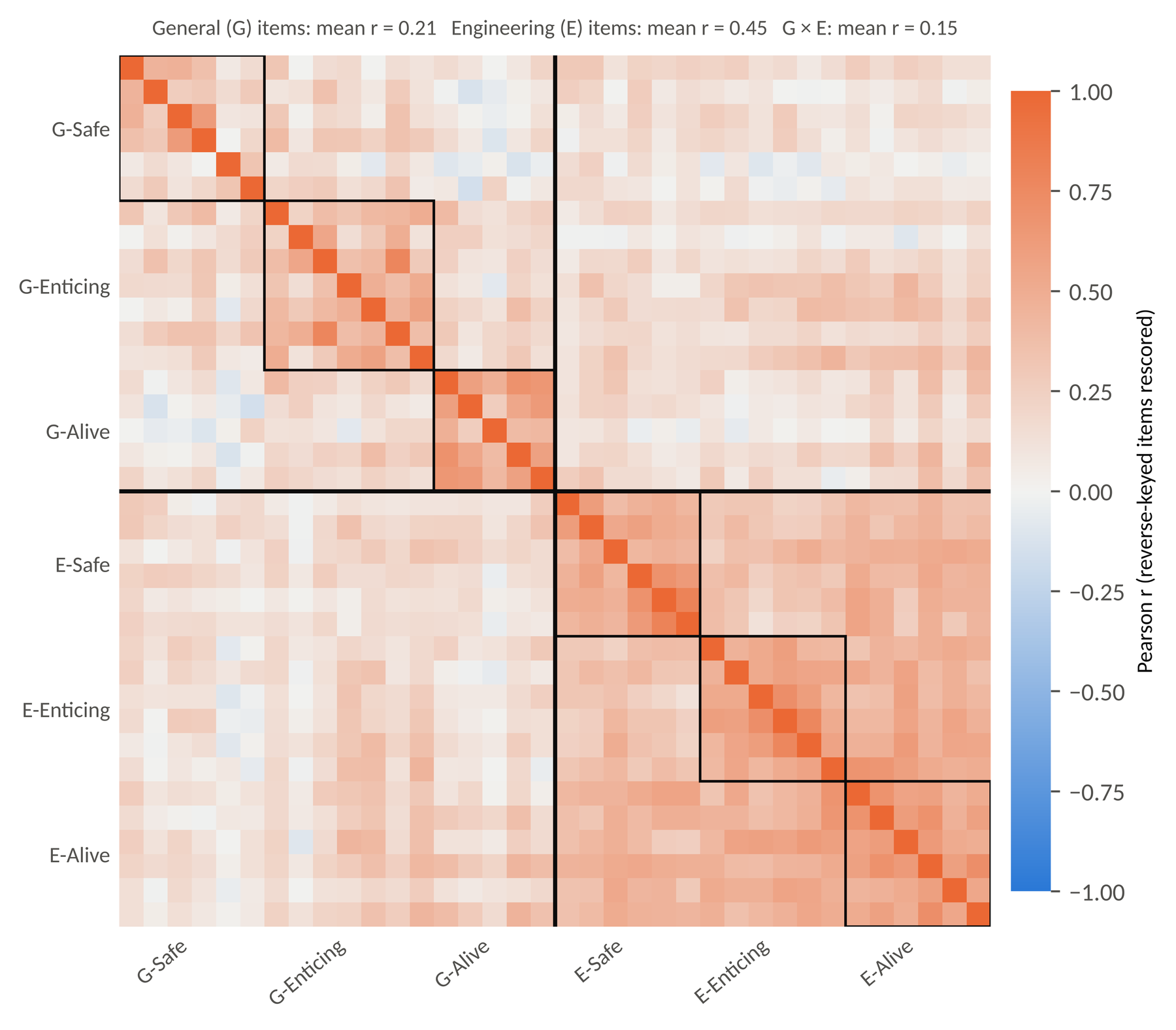
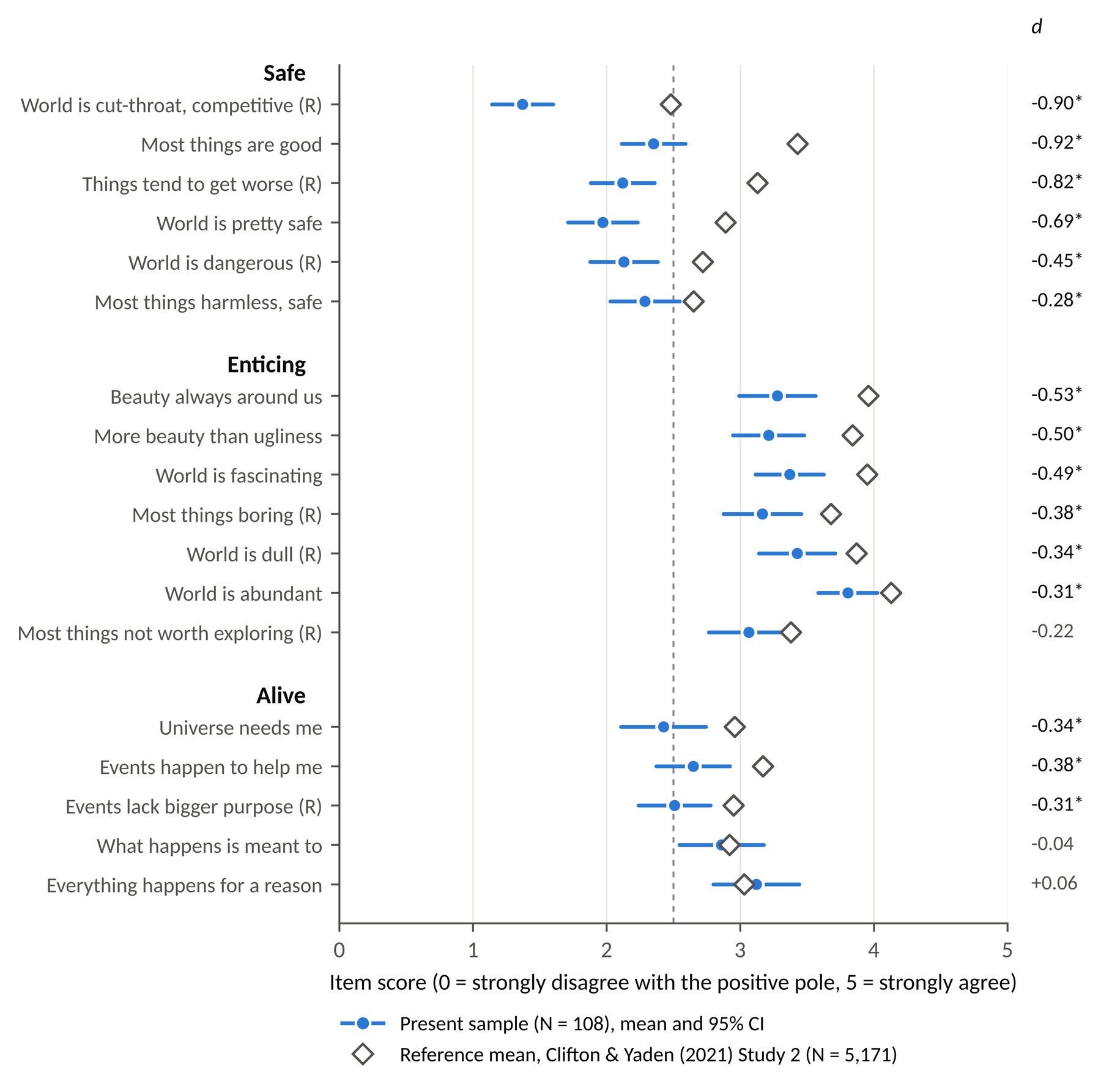
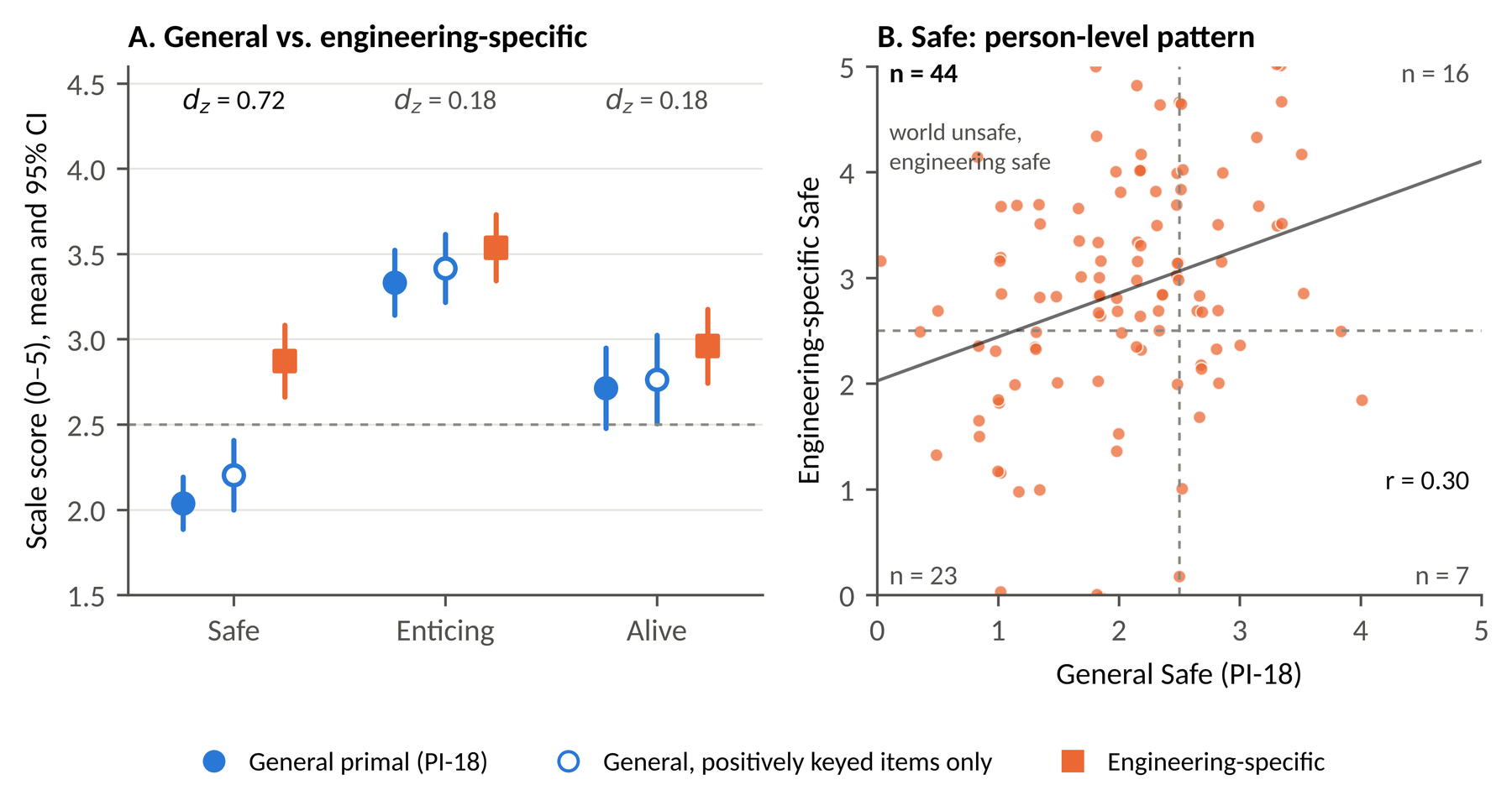
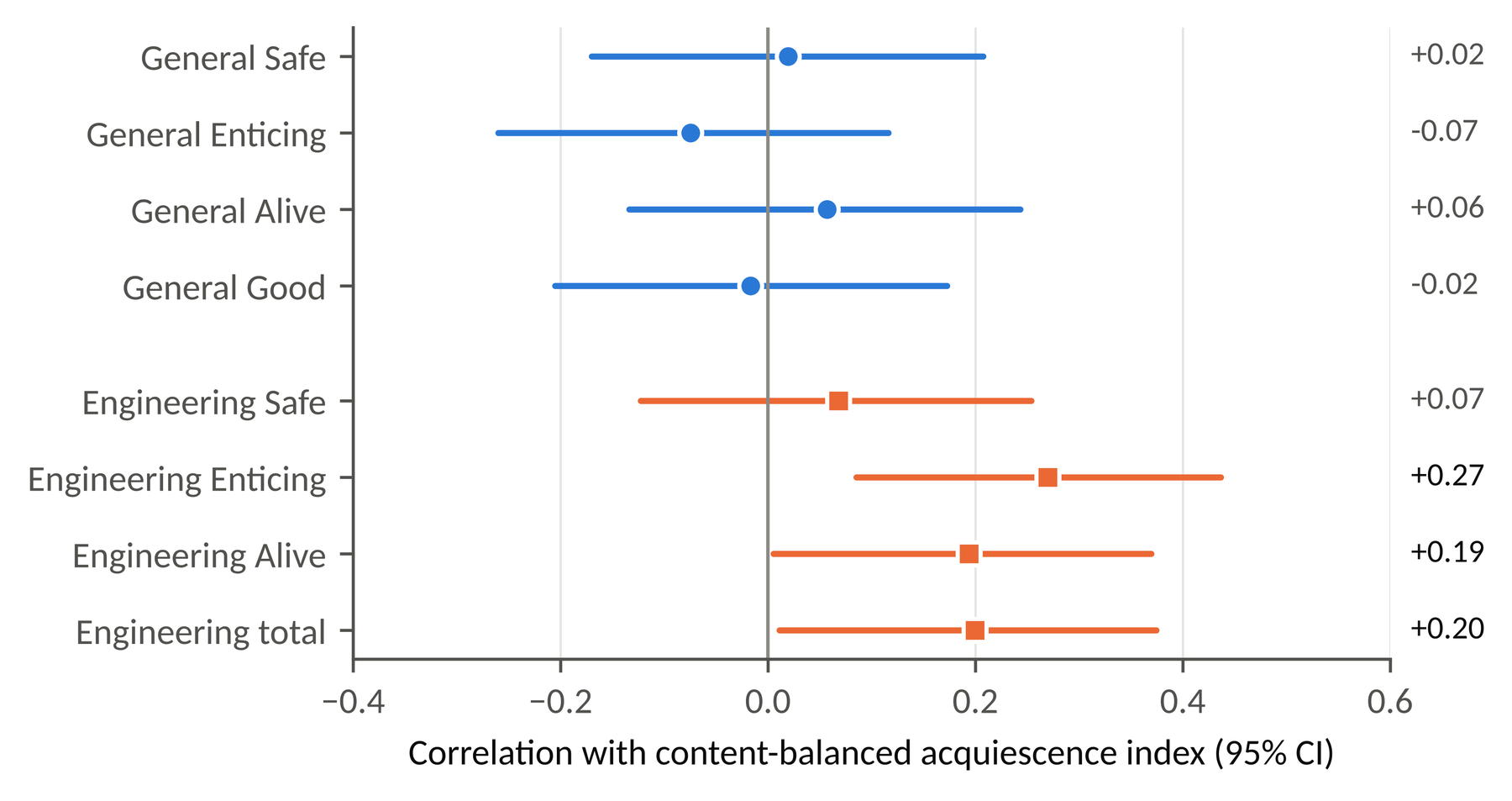
Primal world beliefs (primals), people's most basic beliefs about whether the world is Safe, Enticing and Alive, predict well-being but have rarely been studied in non-Western students or alongside beliefs about a specific domain. A convenience sample of 108 Indian engineering undergraduates (aged 17–25) completed the 18-item Primals Inventory (PI-18) and 18 new, positively keyed engineering-specific items. Relative to published reference values, students saw the world as markedly less Safe (d = −1.06), with the largest deviations on items describing the world as cut-throat and competitive (86.1% agreed) and as bad. Yet they rated engineering as substantially safer than the world (dz = 0.72, 95% CI [0.51, 1.00]); this elevation persisted when only positively keyed general items were compared (dz = 0.50) and was specific to Safe, with negligible differences for Enticing and Alive. General primals explained only 12%–22% of the variance in engineering-specific beliefs. Measurement analyses showed that reverse-keyed PI-18 items formed a method factor, and that the all-positive engineering items were dominated by one general factor and partly contaminated by acquiescence, except for the Safe subscale. Students may treat engineering as a protected pathway within a threatening world, consistent with compensatory-control and effort-justification accounts that require longitudinal testing. Domain-specific primal measures need balanced keying, and PI-18 studies in India should model keying effects.
Keywords: PI-18, Worldview, Career Security, Acquiescent Responding, Reverse-Keyed Items, STEM Higher Education
Key results
Findings
- A cut-throat world. Students' general primals were below reference values on every scale, most of all on Safe, driven by agreement that the world is competitive and getting worse.
- A safety premium for engineering. Students rated engineering as markedly safer than the world. The gap held under a keying-matched comparison and was specific to Safe. Engineering was not seen as more enticing or purposeful than the world.
- Loose coupling. General primals explained only 12%–22% of the variance in engineering-specific beliefs, which favours differentiation over a simple top-down “lens” account.
- Keying matters. Reverse-keyed PI-18 items formed a method factor. The all-positive engineering items were dominated by a general factor and partly inflated by acquiescence, except the Safe subscale.
Figures
Paper, data & code
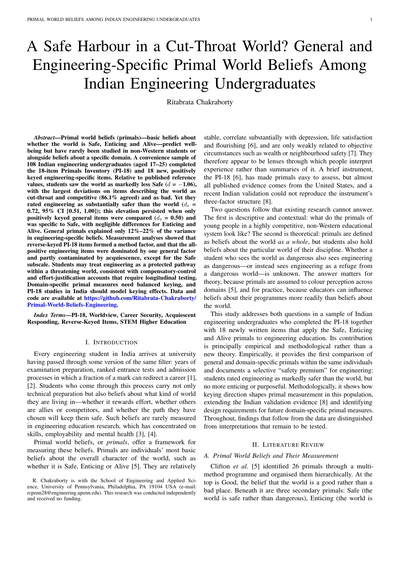
- Full paper (PDF), including supplementary material: EPB-18 item wording, item-level results, sensitivity analysis and codebook.
- De-identified data (N = 108; state recoded to region, time stamps removed).
- Analysis code. A fixed bootstrap seed reproduces every reported statistic.
- LaTeX source
Citation
@misc{chakraborty2026safeharbour,
  title     = {A Safe Harbour in a Cut-Throat World? General and Engineering-Specific
               Primal World Beliefs Among Indian Engineering Undergraduates},
  author    = {Chakraborty, Ritabrata},
  year      = {2026},
  note      = {Preprint},
  url       = {https://ritabrata-chakraborty.github.io/Primal-World-Beliefs-Engineering/}
}